

From the Silk Road to Capri: The Making of De Rijke & Co
A conversation with the founder of De Rijke & Co. on evolving from the Amalfi and reflecting on process, patience, and the value of doing things differently.
Careers rarely follow a straight line, especially for designers who end up building things they never intended to make. For Laurens de Rijke, that path can be traced back to an elementary school visit to a friend’s house, where he found himself face to face with a woodworking shop and a massive grand piano. At the time, he had no way of knowing that this early exposure to gears, pulleys, levers, and making things with his hands would eventually place him among the most compelling young voices in modern watchmaking.
Nor could he have known that years later, while chasing a dream of working in the automotive industry and riding a refurbished Vespa along the Silk Road, a stop at a local market and a Vostok mechanical watch would spark an idea that would consume the next decade of his life.


From Amalfi To Capri
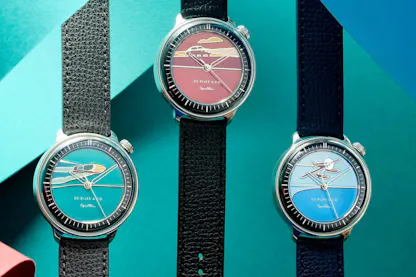
Laurens’ backstory is, by now, fairly well documented. Since the release of his first watch, the Amalfi, in 2019, De Rijke & Co. has steadily expanded its identity. The Amalfi has appeared in multiple iterations, from the playful Miffy Moonphase in various dial colors, including a special pink edition created with the team at Revolution, to the ambitious three part Air, Land, and Sea enamel series produced in collaboration with Guy Allen.
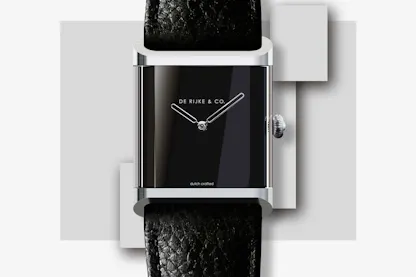
But the reason we are talking about Laurens today is the release of his second model, the Capri. A curved rectangular watch whose DNA is pulled directly from nights spent on the Italian island, the Capri represents both a visual and technical evolution for the brand. I had the chance to sit down with Laurens over a video call to discuss the growth of De Rijke & Co., the inspiration behind the Capri, the nearly fifty prototypes it took to get there, and where he sees his eponymous brand heading next.

Inside The Workshop
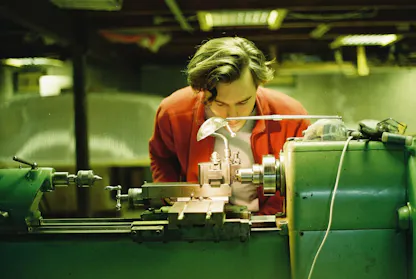
When we connected, a CNC machine hummed quietly in the background, a single lamp illuminating its work. Laurens’ long hair fell to one side as machine parts dotted the space around him, all framed by the window of our video chat. When I asked how he was doing, in the middle of launching a new watch, he smiled and said simply, “It’s been crazy.” It was all that needed to be said.
Having interviewed a number of independent watchmakers over the years, especially those working out of small workshops, I have come to recognize a familiar look, equal parts exhaustion, focus, and innocent bewilderment. I say this with the utmost respect, but if you have ever taken a college math course and had a teaching assistant who always looked as if he had been sleeping on the office couch for months, you will understand the energy. Laurens carries that same quiet intensity, a sense of hyper intelligence paired with genuine surprise at what he has created, and why anyone halfway across the world would want to talk to him about it.


Design And Mechanics
Laurens never set out to make watches. But as someone trained in industrial design, the intersection of form and mechanics has always felt instinctive. From the Amalfi’s rotating case, designed to turn ninety degrees for easier reading while driving, or in Laurens’ case, riding a Vespa across the Silk Road, to the flowing steel curves of the Capri, his design language remains unmistakably his own.
When asked about this intersection of design and mechanics, Laurens was characteristically understated. “Well, I find both very interesting,” he said. “With the Amalfi, I was trying to do something technically different. There is a lot of time and cost involved in that… which people do not always realize, because the watch industry is built around standardization.”
Unlike the Cartier Asymétrique or the Vacheron Constantin Historiques 1921, both of which could be considered driving watches with offset dials, the Amalfi’s dial rotates within the case itself. The mechanism engages with a deeply satisfying click, allowing the watch to be worn comfortably both while driving and off the road.

The Process
“When you want to do something different,” Laurens continued, “you either have to pay a lot of money and go to Switzerland to work with engineers, or you have to develop it yourself.”
That philosophy shaped the early years of De Rijke & Co. When Laurens launched the brand nearly a decade ago, his goal was not simply to make a watch, but to make something meaningfully different. The challenges he encountered while developing the Amalfi forced him to learn every part of the ecosystem, from suppliers to manufacturing constraints. By the time he began work on the Capri, he knew the players, understood the limitations, and had a clearer sense of how to move an idea from sketch to reality.

His technical background gave him a strong understanding of what was possible. The real challenge was finding the right people to help execute it. One example is the curved sapphire crystal used on the Capri, which exposes the edges of the stone dials beneath. Stone dials are historically cut and polished flat, not curved, and it took considerable time to find partners capable of executing that level of complexity.
After the Amalfi, Laurens felt he had earned a certain freedom. “I could let a bit of the technical side loose,” he said, “and just let the design speak for itself.”
When asked about the design process behind the Capri, Laurens’ eyes lit up. “Oh wait, let me show you something,” he said, before disappearing briefly off screen. He returned holding a ziplock bag filled with gray 3D printed case prototypes. Nearly fifty of them, by his count.
One by one, he sorted through the pieces, explaining the evolution in real time. What began as a squared case slowly softened as the lugs turned inward, the sapphire became domed, and eventually the crystal flowed seamlessly into the case itself. The progression was visible and immediate, a physical record of decisions made and reconsidered.
Laurens explained that he would wear each prototype for a period of time, paying close attention to how it made him feel, then make small adjustments. The starting point was clear. He wanted a dress watch. He has long admired the Cartier Tank and the Jaeger LeCoultre Reverso, and the Capri was his attempt to create a personal interpretation rather than a direct homage.

The Capri
A recurring theme in the process was balance. Balance between the curved sapphire and the hidden lugs, and in how those lugs sweep like a wave behind the case. Once the case design was resolved, the movement choice became obvious. Because of the size constraints, an automatic movement was never a real option. Instead, Laurens selected the hand wound La Joux Perret D100.
The result is a watch measuring just 6.5 millimeters thick, with a 38 millimeter lug to lug length and a 28.5 millimeter width. The case and crystal alone took roughly a year and a half to finalize, the result of constant iteration and refinement. As Laurens noted, this was only one part of his workload, as he continues to handle a significant portion of the manufacturing and assembly process in house.
“When I come to the final design, or what ends up being the final design, I can say, okay, this is it, and I focus on it,” he said. “I know there is insecurity there. I guess you could say I am afraid of failure.”
Spoken like a true artist.

The Dials
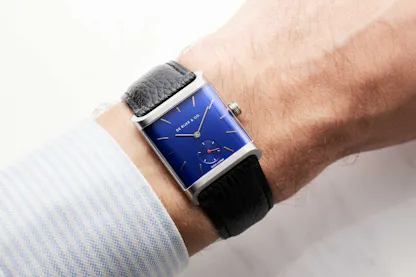
Then there are the dials. The Capri is offered in black onyx, Laurens’ personal favorite, black aventurine, and what he calls Capri Blue. To a certain extent, De Rijke has become known for his dials. From the enamel work created with Guy Allen to the playful Miffy Moonphase, his watches have consistently featured surfaces that feel intentional and distinct.
The original Amalfi 1 series was far more restrained, almost classical in its dial design. With the Capri, however, the use of stone, while admittedly aligned with broader industry trends, becomes something more defining. The curved sides of the case and crystal expose the rounded edges of the stone, turning the material itself into part of the architecture rather than a flat surface.

As for the black aventurine, Laurens was refreshingly straightforward. It simply worked with the design.
The most expressive option is Capri Blue, a bold and deeply saturated tone with an unexpected backstory rooted in the work of Yves Klein. While visiting the Museum of Modern Art in New York last year, Laurens encountered Klein’s iconic blue for the first time.
“At first I thought I am not really into abstract art,” he admitted. “I remember thinking, this is just blue. But when you see it in real life, it does something. It is strange. There is this texture to it, and the more I looked at it, the more I was blown away.”
The impression stayed with him long after he left the museum. Laurens even went so far as to recreate the color, painting a similarly shaped rectangular swatch in his living room. From there, the connection became obvious.
“If you are on Capri and you look out, all you see is the sea, the Mediterranean,” he said. “It was too fitting not to use that color.”

Looking Forward
I asked Laurens about his decision to draw inspiration from two places in Italy, especially given how widely traveled he is and how easily he could point to countless beautiful locations around the world. His answer was disarmingly simple. He loves Italy. The country makes him think of winding roads and long drives in a classic car, and to him, the names Amalfi and Capri are simply beautiful words. At this moment, he said, they just worked.
When asked whether he could imagine drawing from another location in the future, he did not hesitate. The Pamir region, spanning Tajikistan and Kyrgyzstan, immediately came to mind. Still, Laurens was quick to temper that ambition. While he may carry a broader vision for where the brand could eventually go, he is deliberate about moving slowly, one step at a time.
That sense of restraint came into focus when I asked him what he credits his success to, particularly in an industry crowded with young startups all trying to break through and make a name for themselves. Laurens paused. His success, it seems, has been there from the beginning, though he admits he still wonders how he found his place within such a small, tight knit community, especially as something of an outsider.
Ultimately, he believes it comes down to a balance of originality and the technical knowledge to actually execute an idea, a combination that continues to resonate.
“I want to develop things that I really feel personally good about,” he said. “I try not to follow the market too much. I think that is what it comes back to. Just being very original and wanting to create something unique.”
It is a simple philosophy, but one that feels increasingly rare. And for Laurens de Rijke, it seems to be working.